
UK (University College London) Ancient water source found during modern pipeline excavations
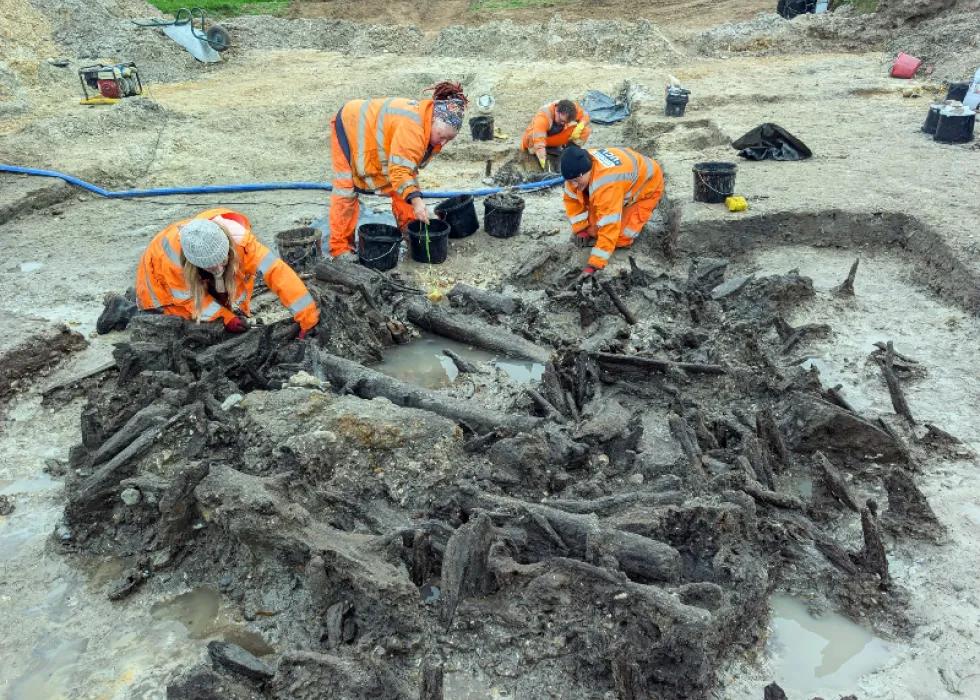
Five well-preserved wooden water wells dating as far back as the Iron Age have been discovered in Hampshire by archaeologists from Archaeology South-East, part of the UCL Institute of Archaeology.
The wells tap into a natural spring and were likely used as a water source for people in the region for hundreds of years. Radiocarbon dating found one of the wells was constructed in the Early Iron Age between 719 and 396 BC, likely supplying water to nearby Iron Age communities. Pottery fragments found in and around the wells revealed that people continued to use this water source into the later Roman period.
Excavation lead Rachael Geoghegan (UCL Archaeology South-East) said: “It is rare and exciting to find wooden structures from this period. The oxygen-starved conditions caused by the wet soil around the spring prevented the wood’s decomposition, preserving the ancient timbers in exquisite detail. We can even see axe marks on some of the timbers.”
The four wells thought to date to the Iron Age were made from hollowed-out oak tree trunks slotted into pits, the largest of which measures 70 centimetres in diameter. One was supported by a ring of stakes, and another showed evidence of repair during its use, with a wooden shovel blade used to support a broken section.
The fifth well was constructed during Roman times and was built differently than those from the Iron Age. Rather than using hollow logs, the Roman builders dug a shallow rectangular pit and lined it with timber planks and stakes. Initial identification suggests that oak was also primarily used to construct this well, with both large timbers and roundwood stakes indicating use of wood from saplings and older trees.

Waterlogged wood specialist Hannah Street (UCL Archaeology South-East) said: “It’s a great opportunity to work on a site with such exceptionally well-preserved wood. Working closely with our conservator we carefully lifted the Iron Age hollowed logs in as complete a condition as possible. The Roman well in particular required meticulous excavation and recording to untangle the different phases of its timber construction.”
Also at the site, the team used photogrammetry to create a sequence of 3D models of the well that recorded the location of the timbers as the excavations progressed.
The wells were uncovered north of Southampton during excavations ahead of the construction of a new water pipe linking Otterbourne and Southampton funded by Southern Water.
Phil Maunder, Project Manager at Southern Water, said: “This is a terrific find, and one that contrasts a two-thousand-year-old water source and a modern water project. We’re investing over £100million in the Southampton Link Main scheme, a new 19-kilometre pipeline that will help address Hampshire’s drought-period water shortfall and play a vital role in keeping taps and rivers flowing for future generations.”
At UCL Archaeology South-East’s lab in Portslade, specialists are continuing to analyse the finds and soil samples from the site. They hope that the timbers, artefacts, preserved pollen and plant remains will reveal how the site was used, what the local environment was like, and when the site fell out of use.

The timbers need an environment free of oxygen to survive, so they are being preserved in large tanks full of water. Researchers are continuing to study them, recording any tool marks and joints that might offer insights into how the wells were constructed.
They’re also working to date some of the Roman well timbers using dendrochronology, a technique which compares patterns in a tree’s growth rings, to help establish more precisely when the well was built.
Hannah Street added: “These wells provide a fascinating window into how technology developed from the Iron Age through to the Roman period, revealing changing approaches to construction and water management.”
Links
Images
- (Top) Archaeologists excavate the Roman well. One of the Iron Age wells can be seen being excavated by a fourth archaeologist in the background.
- (Middle) Two Iron Age wells being carefully wrapped and supported for transportation back to the lab.
- (Bottom) Archaeology South-East team members lifting one of the timbers from the Roman well.
- All credit: UCL Archaeology South-East