A World Association for Sustainable Development initiative

- Other SDGsHUBs
- Join SDGsHUBs
- Get directions
- Share
- prev
- next
Overview
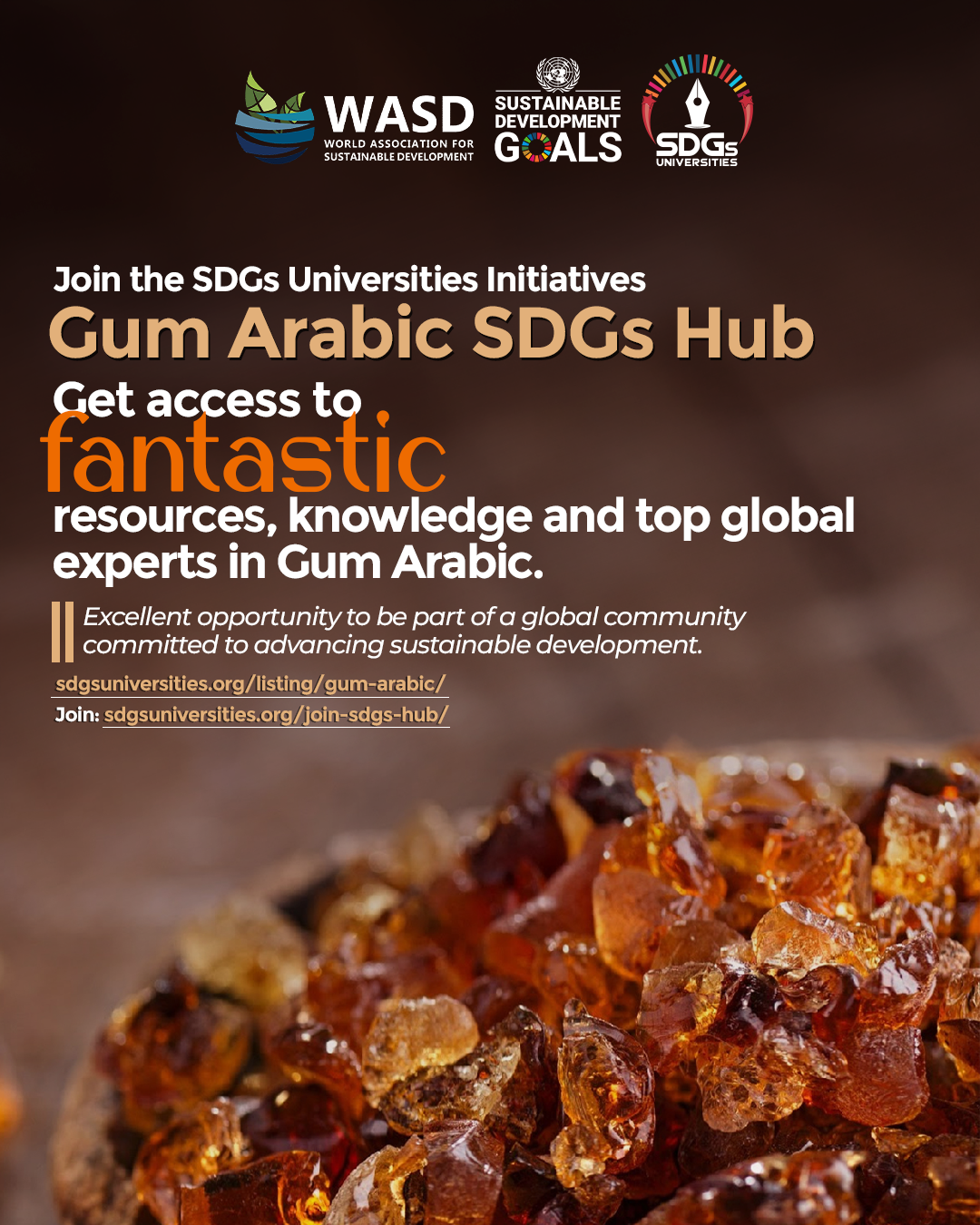
The meaning of Gum Arabic can be described in terms of botanical origin, chemical composition, physical properties, and commercial uses.
As an important SDG Hub, the different activities (teaching and research) in this hub will hopefully improve our knowledge and application of Gum Arabic.
Research Funding and Support: Increase funding for Gun Arabic research to support innovative projects and attract talented researchers. This can be achieved through partnerships with government agencies, private companies, and non-profit organizations. Adequate funding enables researchers to conduct in-depth studies, develop new technologies, and scale up successful interventions. It also allows universities to invest in state-of-the-art facilities and resources that facilitate cutting-edge research.
Resource Integration and Sharing: Universities' libraries expand their collections in the field of Gum Arabic, including books, periodicals ,reports ,etc. And build an academic resource sharing platform to enable teachers and students to access cutting-edge research findings conveniently. Meanwhile, integrate hardware resources such as on-campus laboratories and practice bases to provide support for teaching practices and research projects. For example, establish a Gum Arabic simulation laboratory where students can simulate scenarios for participation practice, and researchers can also conduct experimental research.
Building Cooperative Platforms: On the one hand, promote interdisciplinary cooperation within the university and form interdisciplinary research and teaching teams. Personnel from multiple disciplines such as sociology, information technology, and urban planning work together to jointly develop courses and carry out research. For example, develop the course “Smart Gum Arabic “to study how intelligent technologies can optimize community engagement models. On the other hand, strengthen university-institution cooperation, establish long-term cooperative relationships with various laboratories, and carry out projects together. The university provides professional knowledge and human resources to the laboratories, while the laboratories provide practice sites and real-world data for teaching and research.
Practice-project-driven Approach: Set up practice projects based on actual problems, which run through teaching and research. Students participate in projects such as experiments of the compositions, applying theoretical knowledge to solve practical problems and enhancing their practical abilities. Researchers, based on these projects, deeply explore the origins and characteristics of Gum Arabic, providing vivid cases for teaching, and forming a virtuous cycle of mutual promotion between teaching and research.
Construction of Teaching Staff: Encourage teachers to participate in practices and academic exchanges to improve their professional qualities. Teachers can take on off-campus positions in laboratories to understand practical needs and integrate their experiences into teaching and research. At the same time, invite experts and industry elites to serve as part-time teachers or visiting researchers, participate in teaching and research guidance, and bring front-line practical experiences and industry trends.
Location
London Institute of Sustainable Development (LISD), London, United Kingdom
Objectives
The characteristics of Arabic gum in various aspects are closely linked to the United Nations Sustainable Development Goals (SDGs), contributing to global sustainable development (SD) in multiple dimensions. Therefore, this research hub aims to explore and analyse these various characteristics.
Promoting Economic Development and Employment: Gum Arabic is derived from specific Acacia trees, mainly distributed in some arid and semi-arid regions of Africa. Its rational development and utilization have formed a complete industrial chain from collection, processing to sales, creating numerous job opportunities locally. For example, Sudan, relying on the Gum Arabic industry, has absorbed a large number of labor forces, achieving SDG1 (No Poverty) and SDG8 (Decent Work and Economic Growth),and reducing wealth gap, contributing to SDG10 (Reduced Inequalities).
Facilitating Industrial Innovation and Environmental Protection: Based on in-depth research on the chemical composition of Gum Arabic, more environmentally friendly and efficient extraction and processing technologies have been developed. During the processing, by precisely controlling reactions, the use of chemical reagents and waste emissions are reduced, which is in line with SDG12(Responsible Consumption and Production).At the same time, it promotes industrial upgrading and drives innovation in upstream and downstream industries, conforming to SDG9(Industry, Innovation, and Infrastructure).
Ensuring Health and Promoting Sustainable Consumption: The physical properties of Gum Arabic make it an environmentally friendly alternative in multiple industries. In the food and cosmetics fields, it replaces synthetic additives, reducing potential risks to human health and contributing to SDG3(Good Health and Well-being).It also reduces dependence on non-environmentally friendly raw materials such as petroleum-based products, promoting SDG12(Responsible Consumption and Production).In the printing industry, it improves the stability of inks and printing quality, reducing waste of resources and practicing the concept of sustainable development.
Improving Quality of Life and Health Level: With its wide range of commercial uses, Gum Arabic plays a key role in industries such as food, pharmaceuticals, printing, and cosmetics. In the food and cosmetics industries, it enhances product quality and stability, promoting sustainable consumption. In the pharmaceutical industry, it improves the drug dosage form and release effect, enhancing the curative effect, helping to achieve SDG3(Good Health and Well-being),and benefiting consumers and patients.
Theme
The Arabic Gum Research Hub will focus on the latest research on this field:
Research on Applications in the Agricultural Field: Researchers are exploring the potential applications of Gum Arabic in agricultural planting, using it as a natural soil conditioner. Gum Arabic can improve soil structure, enhance soil aggregation and aeration, thereby increasing the soil's water-holding and fertilizer-retaining capacity. In arid and semi-arid regions, this property helps reduce water evaporation, improves the water utilization rate of crops, and thus enhances the drought resistance of crops. Some experiments have shown that adding an appropriate amount of Arabic gum to the soil can significantly increase the germination rate and seedling survival rate of crops such as wheat and corn, and promote the growth and development of plant roots, providing a favorable soil environment for the healthy growth of crops.
Research on Wastewater Treatment: Given the special chemical structure and physical properties of Gum Arabic, it shows certain application prospects in the field of wastewater treatment. Studies have found that Gum Arabic can interact with heavy metal ions and organic pollutants in wastewater, and remove these pollutants from the wastewater through adsorption, complexation etc. Thus, achieving the purpose of purifying water quality. Compared with traditional wastewater treatment methods, using Arabic gum for wastewater treatment has advantages such as low cost and environmental friendliness, and is expected to become a sustainable wastewater treatment technology.(Water Research: Gum Arabic-mediated Removal of Heavy Metals and Organic Pollutants from Wastewater)
Research and Development of Bio-based Materials: With the increasing awareness of environmental protection, the demand for bio-based materials is growing. As a natural biopolymer material, Gum Arabic has good biocompatibility and biodegradability, making it a popular subject in the research and development of bio - based materials. Scientists are trying to compound Gum Arabic with other natural polymer materials to prepare bio-based materials with specific properties, such as biodegradable plastics and bio-composites. These materials can be widely used in packaging, medicine, construction, and other fields, helping to reduce dependence on traditional petroleum-based materials and reduce environmental pollution.(Biomacromolecules: Development of Bio-composites Based on Gum Arabic and Natural Polymers)
Research on the Impact on Skin Health:In today’s society, research on the impact of Gum Arabic on skin health is gradually increasing. Arabic Gum has properties such as moisturizing, anti-inflammatory, and antioxidant effects. It can help the skin retain moisture, reduce water loss, and relieve skin problems such as dryness and itching. Its antioxidant effect can scavenge free radicals in the skin, delay skin aging, and reduce the appearance of wrinkles and age spots. At the same time, its anti-inflammatory property helps to reduce skin inflammation and has a soothing and repairing effect on sensitive skin. Therefore, an increasing number of cosmetic formulations are starting to add Gum Arabic to enhance the skin-care efficacy of products.(International Journal of Cosmetic Science: Exploring the skin beneficial Properties of Gum Arabic in Cosmetic Formulations)
Expansion of Applications in Microencapsulation Technology:Microencapsulation technology is a technique that encapsulates solid, liquid, or gaseous substances within tiny capsules, and it has wide applications in food ,medicine, agriculture, and other fields. Due to its unique film-forming and stability properties, Gum Arabic is one of the ideal choices for microcapsule wall materials. Recent research is dedicated to optimizing the application of Arabic gum in microencapsulation technology. By adjusting formulation and process parameters, the encapsulation efficiency and stability of microcapsules can be improved, achieving effective protection and controlled release of the core material. The development of this technology will help improve the utilization rate of active ingredients, extend the shelf-life of products, and broaden the application scope of Gum Arabic in different fields.(Journal of Microencapsulation: Optimization of Gum Arabic-based Microencapsulation for Enhanced Active Ingredient Delivery)
Application in Food Packaging: Current research efforts are focused on the integration of Gum Arabic into biodegradable food packaging materials. Scientists are working on formulating composite materials that combine the unique properties of Gum Arabic with other biodegradable polymers. Gum Arabic can enhance the mechanical strength of the packaging, making it more resistant to tearing and puncturing during handling and storage. Additionally, it can improve the barrier properties of the packaging, reducing the permeability to oxygen, moisture, and other gases. This helps to extend the shelf-life of food products by preventing spoilage and oxidation. What’s more, the biodegradability of Gum Arabic ensures that the packaging materials can break down naturally in the environment, reducing the environmental impact associated with traditional non-biodegradable packaging materials. Research is also being done to optimize the processing conditions for incorporating Gum Arabic into food packaging, aiming to make the production process more cost-effective and scalable for industrial applications.
Global Challenges
The field of Gum Arabic holds significant potential in contributing to the resolution of several major global challenges:
Food Security
- Ensuring Stable Food Supply: Gum Arabic is a versatile additive in the food processing industry. In the production of dairy products like yogurt, it acts as a stabilizer. By preventing the separation of milk proteins and fats, it ensures a consistent texture and quality throughout the product's shelf life. This is crucial as it reduces the likelihood of spoilage, allowing for longer storage and wider distribution, even in regions with limited cold-chain infrastructure. For example, in tropical countries where temperature fluctuations can accelerate food spoilage, Gum Arabic-stabilized products can remain fresh for a longer time.
- In the beverage industry, especially in carbonated drinks and fruit juices, Gum Arabic is used to emulsify flavors and prevent the separation of ingredients. This ensures that consumers get a uniform taste experience with every sip. By maintaining product quality during storage and transportation, it helps in maintaining a stable food supply, reducing food waste due to quality degradation.
Enhancing Food Nutrition
Through microencapsulation technology, Gum Arabic plays a vital role in improving food nutrition. It can encapsulate essential nutrients such as vitamins(e.g., vitamin C, which is easily oxidized)and minerals(like iron).This protection allows these nutrients to remain stable during food processing and storage. In the case of fortified foods, the controlled-release property of Gum-Arabic-based microcapsules ensures that the nutrients are released gradually in the body, improving their bioavailability. For instance, in breakfast cereals fortified with vitamins, the use of Gum Arabic-encapsulated vitamins means that consumers can better absorb these nutrients over time.(Gum Arabic: A versatile natural gum: A review on production, processing, properties and applications)
Environmental Protection
- Advanced Wastewater Treatment: In wastewater, heavy metal ions(such as Lead, Mercury, and Cadmium)and organic pollutants pose a significant threat to aquatic ecosystems and human health. Gum-Arabic has a unique chemical structure with functional groups that can bind to these contaminants. Its polysaccharide and protein components form complexes with heavy metals through chelation and with organic pollutants through physical adsorption.
- In laboratory-scale experiments and some pilot-scale applications, it has been shown that Gum Arabic can effectively reduce the concentration of heavy metals in industrial wastewater. This natural and biodegradable alternative to traditional chemical-based wastewater treatment methods not only reduces the environmental impact of treatment processes but also minimizes the risk of secondary pollution caused by the use of harsh chemicals.
- Promoting Biodegradable Materials: Traditional plastics, made from non-renewable petroleum resources, are a major source of environmental pollution. Gum Arabic, with its excellent biocompatibility and biodegradability, can be combined with other natural polymers like cellulose or starch to create biodegradable materials.
- These materials can be used in a wide range of applications, from food packaging to disposable cutlery. For example, biodegradable food packaging made with Gum Arabic-based composites can break down naturally in the environment within a relatively short period(compared to traditional plastics that can persist for hundreds of years),reducing the accumulation of plastic waste in landfills and oceans.
Sustainable Development
- Sustainable Raw Material Utilization: Gum Arabic is derived from the sap of acacia trees, which are a renewable resource. Encouraging the cultivation of acacia trees for Gum Arabic production can have a positive impact on forestry. It promotes reforestation in areas where acacia trees are native, enhancing biodiversity and providing habitats for various species.
- Following proper guidelines to ensure the health and growth of the trees can create a long-term supply of this valuable raw material. This, in turn, supports industries that rely on Gum Arabic, such as the food, pharmaceutical, and cosmetics industries, with a sustainable and eco-friendly input.
- Economic Development in Arid Regions: Acacia trees are well-adapted to arid and semi-arid environments, which are often characterized by limited economic opportunities. The production and processing of Gum Arabic can serve as a source of income for local communities in these regions. From the collection of Gum Arabic from the trees by local farmers to the processing and value-addition activities in nearby facilities, a whole value chain can be developed. This not only creates direct employment opportunities but also stimulates related economic activities such as transportation, trade, and small-scale entrepreneurship. For example, in some African countries like Sudan, the Gum Arabic industry has been a significant contributor to the local economy, improving the living standards of rural communities.
Research Centres
Conferences
Digital Library
Sorry, no posts were found.
Consult
London Institute of Sustainable Development (LISD), London, United Kingdom
Conatct Us
Please contact the SDGsHub convenors directly if you need help or if you have any question. We are also happy to help you if you do not manage to contact the convenors. Our Head Office teams available in London, United Kingdom but we also have teams across the world working at different time zones such as in Africa and the Middle East. Therefore, the best and quick way to reach us is to contact us by email (admin@sdgsuniversities.org)